Unicast routing

We all know that unicast means that the transmission from a single sender to a single receiver. Most of the traffic on the internet and also an intranet is known as unicast data means that unicast traffic is sent with a specified destination. Unicast is a transmission from point to point means (single sender to a single receiver). It is the simplest form of routing because the destination which is already known. There is various unicast protocol such as TCP, HTTP, etc. 

TCP is one of the uses unicast protocol. It is a connection-oriented protocol that relays on acknowledgment from the receiver side. While HTTP is an object-oriented protocol for communication.

There are basically three types of major routing protocol for unicast routing is:
  • Distance vector routing 
  • Link state routing
  • Path Vector Routing
Unicast routing
Unicast routing
You can also learn some routing techniques listed below:

1. Broadcast Routing
2. Multicast routing
3. Anycast routing

Unicast routing protocol:

Before we learn about unicast routing protocol first let us understand what is unicast. There are types of routing protocol name as intradomain and interdomain. Distance vector and link state is an intradomain routing protocol while path vector is inter-domain routing protocol here this article are described to this three protocol in details.


1. Distance vector routing protocols:

Distance vector is one of the simplest routing protocol which routing decision on the number of hops between source and destination. A route with less number of hops which is considered as the best route. Every router advertises its set best routers. The least cost route between any two nodes is the route with a total minimum distance. Each node maintains a vector of minimum distance to every node. Ultimately all routers build up their network topology based on the advertisement of their peer routers, for example, routing information protocol. 

2. Link state routing:

Link state routing protocol is the second family routing protocol. It is a slightly complicated protocol than distance vector. Link state routing uses link state routers to exchange message that allows each router to learn the entire network topology. All router then calculate their best path for routing purposes. Based on this learned topology, each router is then able to compute its routing table by using the shortest path computation. 

The concept of link state routing
The concept of link state routing 

Basic features of the unicast link state routing protocol: 
  • Link-state packet  considered as a: A small packet that contains routing information
  • Link state database considered as A collection information gathered from link state packet
  • Shortest path first algorithm: A calculations performed on the database results into the shortest path
  • Routing table: A first of known paths and interfaces
The figure shows that a simple five nodes. Each node uses the same topology to create a routing table bit the routing table for each and every node is unique because the calculations are based on different interpretations of the topology. While each and every person may have the same map each needs to take a different route to reach her specific destination.

Link state knowledge
 Build a routing table:
  • Creation of the states of a link by each node called as the link state packet
  • Dissemination of LSP to every other router called flooding in an efficient and reliable way
  • Formation of the shortest path tree for each node
  • Calculations of a routing table on the shortest path tree
Link state routing protocol is to compare with distance vector protocol have the following way:
  • It requires a large amount of memory
  • Shortest path computations require many CPU circles
  • It network uses the little bandwidth
  • It quickly reacts to topology changes
  • No splits horizon techniques are possible in the link state routing
  • Authentication mechanisms can be used to avoid undesired adjacency and problems
  • All neighbors must be trusted in the topology
  • All item in the database must be sent to neighbors to form link state packets 
3. Path vector method:

Distance vector and link state routing both are intradomain routing protocols. These two protocols are not suitable for interdomain routing protocol mostly because of their scalability. Both of this routing protocol became intractable when the domain of operation becomes large. Distance vector routing is subject to instability if there are more than a few hops in the domain of operation. While in path vector routing we assume that there is one node in each autonomous system that acts on behalf of the entire autonomous system.

ULSI full form

What is the full form of ULSI?

  • Ultra Large Scale Integration 

What does ULSI mean?

The USLI means that IC which to placing more than about one million circuit elements on a single chip. The Intel 486 and also a Pentium type of microprocessor, for example, use ULSI technology. The line between VLSI and ULSI is vague.

Explore more information:

Full form of INSAT

What is the full form of INSAT?

  • Indian National Satellite System

What does INSAT  mean?

INSAT is a series of multipurpose GEO-Stationary for satellites launched by Indian space research organization for broadcasting, search, meteorology, telecommunication and rescue operations. INSAT is one of the largest domestic communication systems in the Asia Pacific region. The overall coordination and management of the INSAT system rest with the secretary level INSAT coordination committee.

Advantages and disadvantages of modem

A modem is a basic type of network device that both modulates and also has demodulated for analog carrier signals called as a sine wave for encoding and decoding digital information for processing. A modem is a combination of modulating and demodulating. This post gives information about the advantages and disadvantages of a modem to better understand this topic.

Advantages of the modem:
  • More useful in connecting LAN with the internet
  • Speed depends on the cost
  • Slow speed when compared to the hub
  • A limited number of a system can be connected 
  • A modem is most probably widely used in data communication  roadway
  • A modem converts that the digital signal into an analog signal
Disadvantages of the modem:
  • Acts just as an interface between LAN and internet
  • No traffic maintenance is present
  • A modem is not understood the intermediate process
  • The modem does not know about the own destination path
Explore more information:

Tunnel diode

Definition of tunnel diode:

The tunnel diode is one of the most significant solid state devices which have made their appearance in the last decade. Tunnel diode was invented in the year of 1958 by Leo Esaki. The germanium material is basically used to male tunnel diode. They can also be made from materials as gallium arsenide and silicon materials. The tunnel diode exhibits are also negative resistance in their operating range. therefore it can be used as an amplifier, oscillator and in any switching circuits.

The tunnel diode is heavily doped, highly conductive PN junction diode in which the electric current decreases as the voltage increases. It works on the principle of the method called a tunneling effect. The tunnel diode is used as a very fast switching device in the computer. The tunneling is the phenomenon of conduction in the semiconductor material in which the charge carrier punches the barrier instead of climbing through it. The tunnel diode is a two terminal device with n-type semiconductor called as a cathode and p-type semiconductor called an anode.  It is also used in high-frequency oscillators and amplifier.

Symbol of tunnel diode:

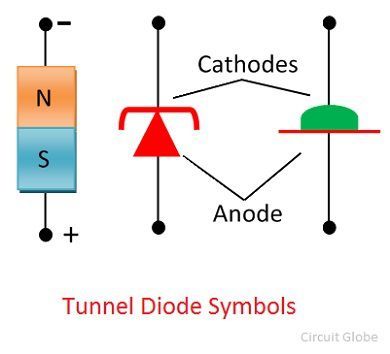
The symbol of the tunnel diode is shown in the figure given below. It is a two terminal device with p-type semiconductor acting as anode and n-type semiconductor act as a cathode. The n-type semiconductor material emits the electron so it named as the cathode while in p-type material attracts the electrons hence it named as the anode.

Tunnel diode symbol

VI characteristics of tunnel diode:
Forward bias condition:
Under the forward bias condition, the immediate conduction occurs in the diode because of heavily doped conduction happen in the diode. The current in the diode reached the maximum current that diode reached a maximum value of Ip and when the voltage applied is Vp across it. The current value is decreased when more amount of voltage is applied. And it current keep decreasing unit it reaches a minimum value. This minimum value of current is called the method valley current Iv. The tunnel diode and normal PN junction diode characteristics are different from each other.
Reverse bias condition: 
Under the reverse bias condition, the tunnel diode act as a back diode or backward diode. In reverse bias condition, the empty state on the n side aligned with the filled state on the p side. The electron will tunnel through a potential barrier. Because of its high doping concentration tunnel diode acts as an excellent conductor.
Tunnel diode characteristics
The graph above shows that A to point of B the value of current decreases with the increases in voltage. So from figure A to B, the graph shows the negative resistance region of the tunnel diode, This region shows the most important property of the diode. Here in this region, the tunnel diode produces the power instead of absorbing it.
Advantages and disadvantages of Tunnel diode:
Advantages of tunnel diode:
  • Low cost
  • Low noise
  • High speed
  • Fabrication is also very simple
  • Fast response
  • Moderate in operation
  • Low power
  • Longevity
  • Ease of operation
  • Environmental immunity
  • Insensitive to nuclear radiation
Disadvantages of tunnel diode:
  • The voltage range, which can be operated properly in 1 volt or below
  • Being two terminal device, it provides no isolation between output and input circuit
  • The low output voltage swing
  • Tunnel diode cannot be fabricated in a large number
Applications of tunnel diode:
  • Tunnel diode can be used as a switch, oscillator, and  also used in the amplifier
  • It is used as an ultra high-speed switch
  • It shows a fast response
  • It is used as an ultra 
  • It is used as a high-frequency component
  • This diode acts as a logic memory storage device
  • This diode can be used as FM receiver since it is a low current device it is not used more
  • It can be used in modern military equipment
  • This can be used as a microwave oscillator at a frequency of about 10 GHz
  • It is used in nuclear magnetic resource machine
  • It can be used in satellite communication equipment
For detailed information

Difference between router and bridge

A router is a device or in some cases software in a computer device which determines the next network point to which a packet should be forwarded toward their destination. A router is located at any gateway include as part of a network switch while the bridge is a product that connects LAN  to another LAN that uses the same protocol. Here this article gives the difference between router and bridge to better understand this topic. 
  • The router operates in the network layer of the OSI model while the bridge operates in a data link layer of the OSI model
  • A router is used to connect the LAN and WAN while in a bridge is used to connect two different LAN segments
  • Router transmit data in the form of packets while in bridge transmit data in the form frames
  • The router reads the IP address of the devices, Bridge read the MAC address of a device
  •  The router has more ports than a bridge, Bridge has only two ports
  • A router uses the table for sending data whereas bridge does not use any a routing table for sending data
  • Router work on more than one broadcast domain while in bridge work on a single broadcast domain
  • A protocol must be used TCP/IP, IPX/SPX, Apple talk while including transparent bridge and translational bridge
  • Router communicates with other routers to decide the best way to transfer the data while in a bridge with the help of MAC addresses of the devices the bridge listen to the network traffic and then decide the way to how to send the data
  • A router uses a software configured network address to determine the address while Bridge determine the destination address with the help of the MAC address of the device
  • The router creates basically multiple paths to send data, but in a bridge does not create multiple paths to send data
  • A router can configure such as RIP, IGRP, OSPF etc, while bridge cannot configure any routing protocols in a bridge
Explore more information:

Advantages and disadvantages of bridge in networking

A bridge network is a basic computer networking device which creates the aggregate network from multiple communication networks or different segment network. Here this article gives information about the advantages and disadvantages of bridge networking or benefits and drawback of network bridge network to better understand this topic. 

Pros or Advantages of bridge networking:

  • It reduces network traffic with minor segmentation
  • It reduces collisions
  • Bridge connects similar network types with different cabling
  • Bridge increase the number of attached workstation and network segments
  • It extends the physical network
  • Bridges also can reduce network traffic on a segment by subdividing network communications
  • It connects different architecture
  • Bridges network can extend a network by acting as a repeater
  • It helps in an extension of physical network
  • It creates separate collision domains. Hence it can increases available bandwidth to individual nodes as fewer nodes share a collision domain
  • Some bridges connect network having different architectures and media types

Cons or Disadvantages of bridge networking:

  • It does not filter broadcasts
  • It is slower compare to repeaters due to the filtering process
  • It is more expensive compared to repeaters
  • Complex network topology, it can pose a problem for transparent bridge
  • A bridge is more expensive than repeaters or hubs'
  • Does not limit the scope of broadcast 
  • Does not scale to extremely large network
  • Buffering and processing introduces delays

Advantages and disadvantages of zener diode

We all know that the Zener diode is a unique diode that allows the current to flow in one direction like a regular diode but is also permits it to flow in the opposite direction. It allows the flow in the opposite direction when the voltage is above some certain value as the Zener voltage. Zener diode consists of a highly doped reversed biased, p-n junction diode while operating in the breakdown region. Here this article gives the advantages and disadvantages of the Zener diode to better understand this topic.

Advantages of Zener diode:

  • The Zener diode is less expensive than another diode
  • This diode can be used in regulate and stabilize the voltage in a circuit
  • These diodes have a high-performance standard
  • Control the flowing current
  • Compatibility and obtainability
  • It can be used in a smaller circuit that would not work with any larger form of the current regulation.
  • They are compatible with the most system due to their lower cost and greater control

Disadvantages of Zener diode:

  • Zener diode cancels out voltage by applying an even larger voltage in the reverse direction wasting electricity in the process.
  • A Zener diode has a relatively poor regulation ratio and is generally not as good as the transistor.

Explore more information:

What is varactor diode

Meaning of varactor diode:

A varactor diode is one kind of semiconductor microwave solid-state device. A varactor diode is a PN junction diode whose capacitance is varied by varying the reverse voltage. These diodes are also named as varicap diodes. A varactor diode is specifically fabricated and optimized such that they permit a high range of changes in capacitance. Before we learn about varactor diode first let us understand the topic of the capacitor.

What is a capacitor?

A capacitor is an electronic component that stores electrical energy or electronic charge in the form of an electric field. The basic capacitor is made up of two parallel conductive plates separated by a dielectric. The two conductive plates act like electrodes and the dielectric act like an insulator. This capacitor, the voltage-dependent device means the output of the diode depends on their input voltage. The varactor diode is used in a place where the variable capacitance is required, and that capacitance with the help of the voltage. This diode also called a volt cap, varicap, voltage variable capacitance or tuning diode. Here first show the figure of the capacitor.


Capacitor symbol

Symbol of varactor diode:


In general, it looks like or similar to that a normal PN junction diode in which one terminal is termed as the cathode and the other terminal is termed as an anode. Here the varactor diode consists of two lines at one end cathode end of normal diode that indicates the capacitor symbol. The one end of a symbol consists of the diode and their other end has two parallel lines.

 varactor diode symbol


Working of varactor diode:

We know that the capacitance of the capacitor is directly proportional to the region of the terminals as the region of the terminals increases the capacitance of capacitor increases when in this mode diode is in the reverse bias mode. The varactor diode is basically made for n-type and p-type of a semiconductor. In n-type semiconductor material the free electrons are the majority carriers while in holes are minority carriers but in p-type of semiconductor holes are the majority carriers and free electrons are the minority carriers. So here when p-type and n-type material are joined together or contact them the PN junction.


This PN junction separates the p-type and n-type semiconductors and the depletion region is created at the PN junction side.  The positive and negative ions make the depletion region. A depletion region is a region where the mobile charge carrier is absent. so diode in reverse bias mode current does not flow. When the diode is connected in forward biasing move the current start flowing through the diode and their depletion region becomes decreases. The depletion region mode does not move from one side to another side. The depletion region blocks free electron from the n-side and hole from the p side region. The depletion-mode region blocks electric current across the PN junction


Depletion region in reverse bias PN junction

Characteristics of the varactor diode

The characteristics of the varactor diode have the following:
  • These diodes are significantly generated less noise compared to other diodes
  • The cost of these diodes is available at lower or more reliable also
  • These diodes are very small in size and very lightweight compared to other diodes
  • There is no use when it is operated in forwarding bias
  • In reverse bias mode, this diode enhanced the capacitance as shown in the graph below

Characteristics of a varactor diode

More detailed information


Advantages and disadvantages of varactor diode:

Advantages of varactor diode:
  • Less noise 
  • The power loss due to noise is low 
  • It is portable due to the small size  
  • Lightweight
  • Reliability
  • It is economical
  • Low cost
  • Small size 
Disadvantages of varactor diode:
  • These diodes are specially designed to work in the reverse biased mode. Hence they are not useful when operating them in the forward bias mode
More detailed information
Read more >> Advantages and disadvantages of a varactor diode


Application of varactor diode:
  • To set LO signal
  • A variable resonant tank LC circuit
  • Electronic application
  • Ultra-high-frequency television sets
  • Harmonic generators
  • Frequency control circuits
  • High-frequency radios
  • Frequency modulator
  • RF phase shifter
  • Frequency multiplier
  • Radio receiver for tunning the circuit
  • Parametric amplifier
  • Bandpass filters
  • Voltage controlled oscillators
More detailed information

Types of diode

The semiconductor diode is a combination of two crystalline semiconductor materials, which designed the two materials know as p-type and n-type. So first let we understand what is n-type and what is p-type of materials

The n-type semiconductor has a larger electron concentration. This is done by introducing a donor as impurities. Here the n-type refers to the negative charge of the electron.

While in p-type of the semiconductor has larger hole concertation, here p-type refers as to the positive charge of the hole.


There are several types of diodes are available for use in electronics design namely a Gunn diode, Laser diode, LED, backward diode, BARITT diode, a PIN diode, PN junction diode, Tunnel diode, Schottky diode, Varactor diode, and Zener diode. Here this article gives the information about what is a diode, what is a Zener diode, different types of Zener diode, application, advantages etc.

The various types of diodes are as follows:

Varactor diode symbol

The symbol of the varactor diode is shown in the figure is given below. The varactor diode symbol consists of with capacitor symbol at the one end of the diode that represents the variable capacitor type characteristics of the varactor diodes to shown in figure.

In general, it looks like or similar to that a normal PN junction diode in which one terminal is termed as the cathode and the other terminal is termed as an anode. Here the varactor diode consists of two lines at one end cathode end of normal diode that indicates the capacitor symbol. The one end of a symbol consists of the diode and their other end has two parallel lines.

Varactor Diode Symbol


Characteristics of varactor diode

The below graph illustrates the relation between the magnitude of reverse bias voltage p-type and n-type layers of a varactor diode, and the magnitude of junction capacitance. They are voltage controlled capacitor and sometimes known as varicap diodes although the word varactor is widely used.

Variable capacitance effect is shown by a normal diode, but the varactor diode is preferred for providing required capacitance changes. The diodes are uniquely optimized and also manufactured such that they enable high range changes in the capacitance device. A varactor diode is categorized based on the properties of a diode junction.

The characteristics of the varactor diode have the following:
  • These diodes are significantly generated less noise compared to other diodes
  • The cost of these diodes is available at lower or more reliable also
  • These diodes are very small in size and very lightweight compared to other diodes
  • There is no use when it is operated in forwarding bias
  • In reverse bias mode, this diode enhanced the capacitance as shown in the graph below

Characteristics of a varactor diode

tunnel diode symbol

The tunnel diode is a highly doped semiconductor device, that is is highly conductive, heavily doped PN junction diode in which the current induces because of the tunneling. The symbol of a tunnel diode is shown in the figure given below. The n-type material emits the electrons and is named as the cathode while P-type material act as the electrons and hence it called as the anode.


tunnel diode symbol

Characteristics of tunnel diode

Forward bias condition:
Under the forward bias condition, the immediate conduction occurs in the diode because of heavily doped conduction happen in the diode. The current in the diode reached the maximum current that diode reached a maximum value of Ip and when the voltage applied is Vp across it. The current value is decreased when more amount of voltage is applied. And it current keep decreasing unit it reaches a minimum value. This minimum value of current is called as the valley current Iv. The tunnel diode and normal PN junction diode characteristics are different from each other.
Characteristics of the tunnel diode
                                           
Reverse bias condition: 
Under the reverse bias condition, the tunnel diode act as a back diode or backward diode. In reverse bias condition, the empty state on the n side aligned with the filled state on the p side. The electron will tunnel through a potential barrier. Because of its high doping concentration tunnel diode acts as an excellent conductor.

The graph above shows that A to point of B the value of current decreases with the increases in voltage. So from figure A to B, the graph shows the negative resistance region of the tunnel diode, This region shows the most important property of the diode. Here in this region shown in, the tunnel diode produces the power instead of absorbing it.

Advantages and disadvantages of Tunnel diode

One of the main reason for the early success of the tunnel diode was its high speed of operation and the high frequencies it could handle. Here this post gives information about the advantages and disadvantages of the Tunnel diode to know more detailed about it.

Advantages of tunnel diode:

  • Low cost
  • Low noise
  • High speed
  • Fabrication is also very simple
  • Fast response
  • Moderate in operation
  • Low power
  • Longevity
  • Ease of operation
  • Environmental immunity
  • Insensitive to nuclear radiation

Disadvantages of tunnel diode:

  • The voltage range, which can be operated properly in around 1 volt or below
  • Being two terminal device, it provides no isolation between output and input circuit
  • The power output levels of tunnel diode are restricted to only a few milliwatts because the applied DC potential must be less than bandgap potential of the diode
Explore more information:

Advantages and disadvantages of varactor diode

The diode whose internal capacitance varies with the variation of reverse voltage such type of diode is known as the varactor diode. The varactor diode always works in reverse bias and it is voltage dependent semiconductor device. It is used in storing the charge. Here this article gives information about the advantages and disadvantages of varactor diode to know more detailed about it.

Advantages of varactor diode:
  • It generates less noise as compared to other PN junction diode
  • The power loss due to noise is low 
  • It is portable due to the small size and  also a lightweight
  • Reliability
  • It is economical
  • Low cost
  • It has a small size 
  • It is reliable you can use it to vary a capacitance
Disadvantages of varactor diode:
  • These diodes are specially designed to work in the reverse-biased mode. Hence they are not useful when operating them in the forward bias mode