What is smps in computer

The disadvantages of linear power supplies (LPS), such as lower efficiency, transformers used are heavier and large, more power is wasted in the form of heat, dissipation is more, etc, overcome by implication of SMPS. First, let us know about what is the full form of SMPS. SMPS is used as a controlled switch.

SMPS is based on the chopper principle. The output of the dc voltage is controlled by varying the duty cycle of chopper by PWM or in FM techniques. The circuit configuration used for SMPS can be classified into three broad categories, namely flyback, half-bridge, full-bridge.


Now let us talk about why go in for SMPS?
  • An ac to dc rectifier operates at a supply frequency of 50 Hz. In order to obtain almost negligible ripple I the dc output voltage, physical size if the filter circuit is required large.
  • This makes the dc power supply inefficient, bulky and weighty.
  • On the other hand, SMPS also work like dc chopper. 
Different kinds :

1. Full bridge converter :

The circuit diagram for a full bridge SMPS is shown in the figure. It consists of an uncontrolled rectifier, four power MOSFETs are used, a transformer with mid tap secondary, two diodes and LC circuit, the function of the control circuit is to sense the output load voltage and to decide about the duty ratio of MOSFETs.

Full bridge converter operates with minimum voltage and current stress on the power MOSFET. It is therefore very popular for high power application above 750 W.
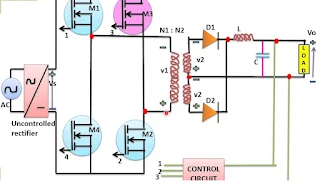

Full bridge converter

2. Half-bridge converter :

The circuit diagram of the half-bridge converter shown in the figure. It consists an uncontrolled rectifier, basically two capacitor C1 and C2, two power MOSFETs M1 and M2, and only one transformer with a mid tap on the secondary side, two diodes D1 and D2 and filter components L and C.

When M1 is totally off, the open-circuit voltage across the M1 terminal is Vs. When M2 is off, as before Voc = Vs. For, half-bridge converters is, therefore, preferred over push-pull converters. 

Half-bridge converter
3. Flyback SMPS :

The circuit configuration for the flyback converter is shown in the figure. It consists of a power MOSFET M1, a transformer for isolation purpose, diode D, capacitor C, and load. An uncontrolled rectifier converts as to dc output which is to flyback SMPS as shown in the figure.

Output power is very less(<100 W) when we are using flyback converter types SMPS and frequently used in low power application.

Flyback SMPS


Advantages  of  SMPS :
  • The efficiency is high as compared to LPS, more than 80 to 90%
  • The device is used in SMPS is compact and very small in size
  • The manufacturing cost is reduced
  • Provide isolation between multiple outputs
  • Low power wastage
  • Less heat generation
  • Lower weight
  • Providing the required number of voltage
  • Reduced the harmonic feedback into the supply mains
  • Wide ac input voltage
Disadvantages of SMPS :
  • Greater circuit complexity
  • The expert design is required
  • The noise to present due to high-frequency switching
  • It produces electromagnetic interference

What is dwell time in wireless communication

The time period for which a call is maintained in a cellular region is called dwell time.

There is some basic factor that influences the dwell time are :
  • propagation
  • Interference
  • The distance between the subscriber and the base station
As the mobile moves from the serving base station (BS), there will drop the signal level. Therefore, the base station generally monitors and measure the signal level before initiating for continuing with the call in progress.

Advantages and disadvantages of schottky diode

A Schottky diode is used in numerous application where other types of diode will not perform very well. They offer a number of advantages on the other hand limitations are also, listed below to know more details about Schottky diode.

Advantages of Schottky diode :
  • High efficiency
  • Fast recovery time so it can be mostly used in the application of high-speed switching
  • Low junction capacitance
  • The low forward voltage drop
  • It can operate high frequency
  • Schottky diode produces less unwanted noise than P-N junction diode
  • High current density
  • Low power consumption. 
  • Rapid response to a change in bias 
  • It has a negligible storage time
  • Low switching time
Disadvantages of Schottky diode :
  • A Schottky diode is more expensive. 
  • They operate at low voltages compare to the P-N junction diode
  • These diodes can't withstand much higher voltage without break down
  • These diodes have relatively higher reverse current
  • It gets heated up quickly in practical.

V-I characteristics of P-N junction diode

P-N junction diode is made up of P-type silicon and N-type silicon semiconductor materials. This article gives the characteristics of the P-N junction diode to know more details about the P-N junction diode.
  • When the anode is positive with respect to the cathode, the diode is to be forward biased. From Vs = 0 to cut in voltage, the forward diode current is very small. 
  • Cut in voltage is also known as threshold voltage or turn on voltage.
  • For a lower power diode, current in the forward direction increases first exponentially with voltage and then becomes almost linear.
  • When the cathode is positive with respect to the anode, the diode is said to be reverse biased.
  • In the reverse biased condition, a small reverse current called leakage current.
  • The leakage current is almost independent of the magnitude of reverse voltage until this voltage reaches breakdown voltage.
  • At this reverse breakdown, the voltage remains almost constant but reverse current becomes quite high limited only by the external circuit resistance.
  • A large reverse breakdown voltage, associated with high reverse current, so power is lost and maybe diode is destroyed.
  • This shows that the reverse breakdown of a power diode must be avoided by operating it below the specific peak reverse repetitive voltage.


What is PN junction diode | Symbol | Application | VI characteristics

A P-N junction diode is a silicon. The P-N junction diode is the basic element for semiconductor diodes. One of the terminals is doped with p-type879 material and the other with N-type of material. The schematic symbol shown in the figure, P-N junction diode is made up of P-type silicon and N-type silicon semiconductor materials.

P-N junction diode is used in a variety of applications like LASER, solar cell, LED, digital logic design, DC power supply, etc. This article also gives many more application listed below.

Symbol of PN junction diode :

Symbol of PN junction diode

Application of PN junction diode :
  • Light-emitting diode application
  • Laser
  • It can be also used solar cells
  • It used in the detector as well as the demodulator circuit
  • It is used in many circuit or diode-like, a switching diode, Zener diode, PIN photo-diode, varactor diode
  • It is used as switches in digital logic design
  • It can be also used p-n junction photodiodes
  • It can be used as a rectifier in DC power supply
  • It is also used clipping circuit
  • It can be also used computers, radios, radars as wave shaping circuit
V-I characteristics of PN junction diode :
  • When the anode is positive with respect to the cathode, the diode is to be forward biased. From Vs = 0 to total cut-in voltage, the forward diode current is very small. 
  • Cut in voltage is also known as threshold voltage or called turn-on voltage.
  • For a lower power diode, the current in the forward direction increases first exponentially with voltage and then becomes almost linear.
  • When the cathode is positive with respect to the anode, the diode is said to be reverse biased.
  • In the reverse biased condition, a small reverse current called as a leakage current.
  • The leakage current is almost independent of the magnitude of reverse voltage until this voltage reaches breakdown voltage.
  • At this reverse breakdown, the voltage remains almost constant but reverse current becomes quite high limited only by the external circuit resistance.
  • A large reverse breakdown voltage, associated with high reverse current, so power is lost and maybe diode is destroyed.
  • This shows that the reverse breakdown of a power diode must be avoided by operating it below the specific peak reverse repetitive voltage shown in the figure.

VI characteristics of PN junction diode
V-I characteristics of a P-N junction diode

This article also gives the various types of diode listed below:

Application of PN junction diode

A lower diode is called a signal diode, it is a PN junction device. A high power diode called power diode is also called as a PN junction device but with constructional features somewhat different from a signal diode. The intricacies in constructing power diode arise from the need to make them suitable for high voltage and some high current applications. Let us have a deep insight into the application about the P-N junction diode to know more details about the P-N junction diode.

The PN junction diode some important applications :

  • PN junction diode is used as a more triple, voltage doubler and quadruples in voltage multiplier circuit.
  • They are used as a switch in many electronics circuits.
  • They are used in power supply.
  • This diode can be used by many circuits rectifiers, varactor for voltage-controlled oscillators.
  • While PN junction diode produced light when biased with a current, so it is used in light-emitting diode application.
  • This diode can be also used for another diode called a light amplification stimulation emission of radiation.
  • In power electronics engineering, it can be used in solar cells.
  • It used in the detector as well as the demodulator circuit so it can be used as a detector for the demodulation circuit.
  • In digital electronics, this diode can be used as switches in digital logic design.
  • It can be used in PN junction photodiodes applications.
  • This diode can be used as a rectifier in the DC power supply.
  • While we are using the clipping circuit, this diode can be used to clip the portion of AC.
  • They are used as clamper to change the reference voltage.
  • Zener diode most commonly used in stabilizing circuits.
  • It can be used as a varactor diode for use in the voltage-controlled tunning circuit as may be found in radio and TV receivers.
  • The voltage across the PN junction biased is used to create temperature sensors and reference voltages.
  • This diode can be used as voltage multipliers to increase the output voltage.
  • It can be used as a signal diode in communication circuits.
  • These diodes must be used in various daily life applications like computers, radios, radars as wave shaping circuits.
  • It is used in many circuits or diode-like, a switching diode, Zener diode, PIN photo-diode, varactor diode.
There are many different types of PN junction diode, let here we have to also cover the application of  various diodes:

So guys if you like our post or you think you have to learn a lot from this PN junction diode and their application in detailed please share and comments below. Thanks and stay connected with ecstuff4u.com

Power semiconductor devices

Silicon controlled rectifier called SCR was first introduced in 1957 as a power semiconductor device the same way other semiconductor devices used as switches or rectifier electronic circuits called switch-mode power supplies. This device is also called a power device or some time it will be used in the integrated circuit, called power ICs.

Most of these semiconductor devices are listed below and it along with device and present advantages is maximum ratings.
  1. Diode - Voltage or current rating - 5000 V/ 5000 A
  2. Full form of SCR(silicon controlled rectifier) - Voltage or current rating - 7000 V/ 5000 A
  3. LASCR called (light-activated SCR) - Voltage or current rating - 6000 V/ 3000 A
  4. ASCR/RCT called (asymmetrical SCR / reverse conducting thyristor) -Voltage or current rating - 2500 V/ 400 A
  5. Full form of GTO called (gate turn off thyristor) - Voltage or current rating - 5000 V/ 3000 A
  6. Full form of SITH called (static induction  thyristor) - Voltage or current rating - 2500 V/ 500 A
  7. Full form of MCT called (Mos controlled thyristor) - Voltage or current rating - 1200 V/ 40 A
  8. Full form of BJT called (bipolar junction transistor) -Voltage or current rating - 1400 V/ 400 A
  9. SIT called (static induction transistor)) - Voltage or current rating - 1200 V/ 300 A
  10. Full form of IGBT called (insulated gate bipolar transistor) - Voltage or current rating - 1200 V/ 500 A
Based on,

  • Turn on and turn off characteristic 
  • Gate signal requirement
  • Degree of controllability
The power semiconductor devices can be classified as under the following category

1. Diode: This is uncontrolled rectifying devices. Their on and off-state are controlled by a power supply.

2. Thyristor: These have controlled turn on by a gate signal. after thyristor is on they remain latched in on state due to internal regenerative action and gate loses control. These can be turn off by the power circuit.

3. Controllable switches: These devices are turned on and turn off by the application of control signals. The devices which behave as controllable switches areas like BJT, MOSFET, GTO, SITH, SIT, and MCT. 

So the device like GTO, BJT, SIT, SITH, MCT, SCR, IGBT is unidirectional current devices, whereas RCT and Triac posses bi-directional current capability.

V-I characteristics of schottky diode

The V-I characteristics of schottky diode is shown in the figure. V-I characteristics of schottky diode is almost similar to the P-N junction.

  • In schottky diode the forward voltage drop is very low compare to the similar to P-N junction diode.
  • The forward voltage drop of shottky diode is 0.2 to 0.3 volts, It generally made up of silicon.
  • V-I characteristics of schottky diode are very steeper compare to the V-I characteristics of  P-N junction diode.
  • As compare to silicon diode the reverse saturation current occurs at a very low voltage.

What is schottky diode

A Schottky diode is one types of electronic component. A Schottky diode is most widely used in the mixer, logic circuit, radio frequency, rectifier, solar cell etc. This article discusses the symbol of Schottky diode, what is Schottky diode, application, V-I characteristics and advantages and disadvantages of Schottky diode compare to P-N diode.

Symbol of Schottky diode :

    
                               Schottky diode
The symbol of the Schottky diode is shown in the figure. In Schottky diode, then types of semiconductor act as the cathode while metal acts as an anode. The Schottky diode has an aluminum-silicon junction.

What is a Schottky diode?

A Schottky diode is one types of electronic component. A Schottky diode has an aluminum-silicon junction.

When Schottky diode is forward biased, free electrons in the n-material move towards the Al-n junction and then travel through the metal to constitute the flow of forwarding current. 

Since metal does not have any holes, so the forward current is due to the movement of electrons only, also have no storage charge and no reverse recovery time.

It can, therefore, be said that rectified current flow in a Schottky diode is by the movement of majority carriers only and the diode is also turn of delay caused by recombination is avoided. As such, Schottky diode can switch off much faster compared to p-n junction diode and also have Schottky diode have a high efficiency it is one types of advantages of Schottky diode.

V-I characteristics of Schottky diode : 

The V-I characteristics of the Schottky diode are shown in the figure. Voltage-current (V-I) characteristics of Schottky diode is almost similar to the P-N junction diode characteristics
  • In Schottky diode, the forward voltage drop is very low compared to the similar to P-N junction diode. 
  • The forward voltage drop of Schottky diode is 0.2 to 0.3 volts, It generally made up of silicon. 
  • V-I characteristics of Schottky diode are very sharper compared to the V-I characteristics of the P-N junction diode.
  • As compared to silicon diode the reverse saturation current occurs at a very low voltage.

Advantages and disadvantages of Schottky diode :

Advantages of Schottky diode :
  • High efficiency.
  • This diode has fast recovery time so it can be mostly used in high speed switching application.
  • Low junction capacitance.
  • Low forward voltage drop.
  • It can operate high frequency.
  • Schottky diode produces less unwanted noise than P-N junction diode.
  • High current density.
Disadvantages of Schottky diode :
  • A Schottky diode is more expensive. 
  • They operate at low voltages compare to the P-N junction diode.
  • This diode can't withstand much higher voltage without break down. 
  • These diodes have relatively higher reverse current. 
  • It gets heated up quickly in practice.
Application Schottky diode :

Schottky barrier diodes are mainly used in high power applications as a rectifier because of their high current density and low forward voltage drop characteristic less power is wasted and so they have widely used in some applications. Let we check the applications of Schottky diode one by one below.
  • Voltage clamping and clipping circuit.
  • Low power TTL logic.
  • Rectifier in power supply.
  • As a switching device.
  • Rectify high-frequency signal.
  • Rf mixer and a detector diode.
  • Solar cell application.
  • Low voltage, high current application.
  • RF mixer and a detector diode.
  • Used in logic circuits. 

Difference between PN junction diode and schottky diode

As compared to the P-N junction diode, a Schottky diode has :
  • Low cut in voltage.
  • High reverse leakage current.
  • The reverse breakdown voltage is very low compared to the P-N junction diode.
Some more comparisons between the Schottky diode and the P-N junction diode are given below

Schottky diode :
  • A Schottky diode is a unipolar device whereas is a bipolar device.
  • A Schottky diode is a high switching speed while a P-N junction diode's switching speed is limited.
  • The Schottky diode has turned on a voltage of around 0.2 V while the P-N junction diode has turned on a voltage of around 0.7 V.
  • Schottky diode depletion region is absent while the P-N junction diode depletion region is present.
  • The Schottky diode has a high operating frequency while the P-N junction diode low operating frequency.
  • Schottky diode electron is the majority carriers in both metal and semiconductor while P-N junction diode electrons are the majority carrier in the n-region and holes are the majority carrier in the p region.
  • In the Schottky diode, the turn-on voltage is very low while the P-N junction diode turns on voltage is high compared to the Schottky diode.
  • Schottky diode forward current due to  the ionic emission (majority carrier transport) while P-N junction diode  forward current due to diffusion current 
  • Schottky diode No recombination on the depletion layer while P-N junction diode recombination on the depletion layer.
Explore more information:

Advantages and disadvantages of cell splitting

Advantages of cell splitting :
  • It improves the S/N ratio
  • It reduces interference which increases capacity
  • It reduces the cluster size
  • System capacity gradually expands as demand
Disadvantages of cell splitting :
  • Handoff is more frequent
  • Channel assignment becomes difficult
  • All cell are not simultaneously so special care have to be taken for proper allocation of the problem
Explore more information:

Advantages and disadvantages of cell sectoring

Advantages of cell sectoring :
  • Better S/I ratio
  • Reduces interference
  • Increases capacity
  • Reduces cluster size
  • More freedom in assigning channel
Disadvantages of cell sectoring :
  • Increases number of antennas per base station
  • A decrease in trunk efficiency
  • Loss of traffic
  • Increased number of handoffs
Explore more information:

Umbrella cell approach in mobile communication

The cell with low traffic speed is called as micro-cells and large high-speed traffic called macro-cells.

A hexagonal cell method is one of the closest approximation of a circle device. It is being typically used for the system.

The smaller cell is grouped and assumed to be under a large cell. This method called as an umbrella cell concept.

It can be used to provide a large area to high-speed users while small area coverage to users that travel at low speeds.

Some advantages of using an umbrella cell concept in cellular technology 
  • Umbrella cell provides a large coverage area to high-speed users.
  • Minimize the number of handoff for high-speed users.
  • Speed estimation can be performed by slop of short term average calculation of receive power.
  • If a high-speed user in large umbrella cell is near the base station and if its velocity is decreasing then the BS stands for  can decide whether to hand the user into the co-located micro-cell without the intervention of the mobile switching center (MSC stands for).
  • Provide additional micro-cell channel for pedestrian user.
Umbrella cell concept

Cell splitting

Cell splitting is a method of subdividing cell into a smaller sized cell. In this cell, the parent cell that was originally congested is called as macro cells and the smaller cell called microcells.

The most important benefits for cell splitting is that it increases the cellular capacity of the system where the frequency reuse techniques can be efficiently implemented

Each microcell has a base station antenna. The radius of the microcell is half a radius of the macro cell.

In cell splitting, if the increased number of a cell will increase the number of clusters over the coverage area and will increases the number of channel per unit area so that the capacity of the system is increased.
For the new cell to be a smaller size, the transmitted power must be decreased. in this process, the large macro cell is dedicated to high traffic. In macrocell, the number of hands offs will be less than and also have the call process can be smoothly carried in larger cells.

While in Cell sectoring is one another method to increase the capacity of the system. It keeps the radius of the cell constant and  also decreases the co-channel reuse ratio D/R to reduce the cluster size N, so it is a major difference between them 

This post also gives some advantages and disadvantages of cell splitting to know more details about this concept.

Advantages of cell splitting :
  • It improves the S/N ratio.
  • It reduces interference which increases capacity.
  • It reduces the cluster size.
  • System capacity gradually expands as demand.
Disadvantages of cell splitting :
  • Handoff is more frequent.
  • Channel assignment becomes difficult.
  • All cell are not simultaneously so special care have to be taken for proper allocation of the problem.

Cell sectoring

Cell sectoring is replacing with an omnidirectional type of the antenna at the base station by several types of a directional antenna. It is done mainly to reduce factors such as a co-channel interface. 

Some important points on cell sectoring :
  • Cell sectoring is another method to increase capacity. It keeps the radius of the cell constant and decreases the co-channel reuse ratio D/R to reduce the cluster size N. 
  • Cell sectoring is a method of decreasing the co-channel interference and enhancing system performance by using a directional antenna.
  • The size of clusters in a particular service area can be reduced because the cell sectoring increases the signal to interference ratio (SIR).
  • So in cell sectoring process enhancing the system performance by using a directional antenna and reducing the co-channel interference value. here the reduction in the co-channel interference is dependent on the amount of sectoring used.
  • So here in cell sectoring process generally cell divided in 120 ₀  &  60 ₀ sectors.
  • A cell is in sectoring is 120 ₀  then hexagon cell consists of three sectors and if the sector is 60 ₀  then the hexagonal type cell consists of six sectors. 
  • The single to noise ratio improvement allows the cellular provider to decreases the cluster size N in order to improve the frequency reuse and thus, the system capacity. 
120 ₀  and 60 ₀  sectoring

Now let us talk about some advantages and disadvantages of cell splitting to know more details about this concept.

Advantages of cell sectoring :
  • Better S/I ratio.
  • Reduces interference.
  • Increases capacity.
  • Reduces cluster size.
  • More freedom in assigning a channel

Disadvantages of cell sectoring :

  • Increases number of antennas per base station.
  • A decrease in trunk efficiency.
  • Loss of traffic.
  • Increased number of handoffs.

Hexagonal geometry cell

Having studied the cellular topology and the concept of employing cellular architecture to increases the cellular capacity, serve subscriber demand so we will consider to characteristics the interference in a cellular topology.

A hexagonal cell is one of the closest approximation of a circle to shown in the figure. It is being typically used for the system.

So now let us talk about why we have to choose hexagonal shape summarized below :
  • Basically hexagonal is close approximation the circular radiation pattern in an omnidirectional base station antenna.
  • Hexagonal allow easy and manageable analysis in a cellular system.
  • In a circular pattern, adjacent circles can have gaps in between or can create overlapping regions.
  • Hexagonal geometry is used then only less number of a cell can cover the entire market.
Hexagonal cell

Application of schottky diode

Schottky barrier diodes are mainly used in high power applications as a rectifier because of their high current density and low forward voltage drop characteristic less power is wasted and so they have widely used in some applications. Let us check the applications of Schottky diode one by one below.

Application Schottky diode :
  • Voltage clamping and clipping circuit.
  • Low power TTL logic.
  • As a switching device.
  • Rectify high-frequency signals.

Rf mixer and detector diode

This diode can be also used Rf mixer and a detector diode. This diode consists of its radio frequency function owing to its switching speed at the highest level of top frequency capability. 

Solar cell application

The solar cells are usually linked to the batteries that are rechargeable, and most batteries with lead-acid since power supply must necessary round the clock. This solar cell would not support the applied charge in reverse and thus a diode would be used in a proportional pattern of the solar cells.

The rectifier in power supply


  • Low voltage, high current application.

  • Used in logic circuits. 
  • Used in AC to DC converter.
  • Used in a radar system.

Power rectifier:

The Schottky barrier diodes also have functions with high power as rectifiers. The high density of current and voltage drop with low forward shows that the wastage of power is the least then the normal PN junction diodes


Applications of Schottky Diode

Schottky diodes have been useful for the industry of electronics that has spotted many applications in diode rectifier because of its unique properties. Here are some of the major areas where it is widely used.


.

Power OR circuits:

This diode would be useful for functions where two different power supplies drive a load like in battery supply. It is important that the power coming from supply should not mix with the others.

Solar Cell Applications:


  • Schottky diodes are used as general-purpose rectifiers.
  • Schottky diodes are used in radio frequency (RF) applications.
  • Schottky diodes are widely used in power supplies.
  • Schottky diodes are used to detect signals.
  • Schottky diodes are used in logic circuits.

Difference between cell splitting and cell sectoring

Cell splitting is a method of subdividing cell into the smaller sized cell. The parent cell that was originally congested is called as macro cells and the smaller cell called as microcells.

Cell sectoring is another method to increase capacity. It keeps the radius of the cell constant and decreases the co-channel reuse ratio D/R to reduce the cluster size N. 


Let we check the difference between cell splitting and cell sectoring : 


Cell splitting :

  • Cell splitting is a method of subdividing cell into the smaller sized cell. The parent cell that was originally congested is called as macro cells and the smaller cell called as microcells.
  • The cell is divided into a smaller cell.
  • In cell splitting the transmit power must be reduced to maintain the S/I ratio.
  • The radius of the cell is decreased and the co-channel reuse ratio D/R is kept constant to improve the capacity.
  • In cell splitting large macro-cell are dedicated to high-speed traffic. The reason for a number of handoffs will be less and call progress can be smoothly done.
Cell sectoring :
  • Cell sectoring is a method of decreasing the co-channel interference and enhancing system performance by using a directional antenna.
  • The cell is divided into 120 and 60 sectors.
  • Cell sectoring improves the S/I ratio using a directional antenna.
  • The radius of the cell is kept constant and the co-channel reuse ratio D/R is decreased to improve the capacity.
  • Cell sectoring decreases the coverage area of a group of channels and increases the number of handoffs.